
SYNC
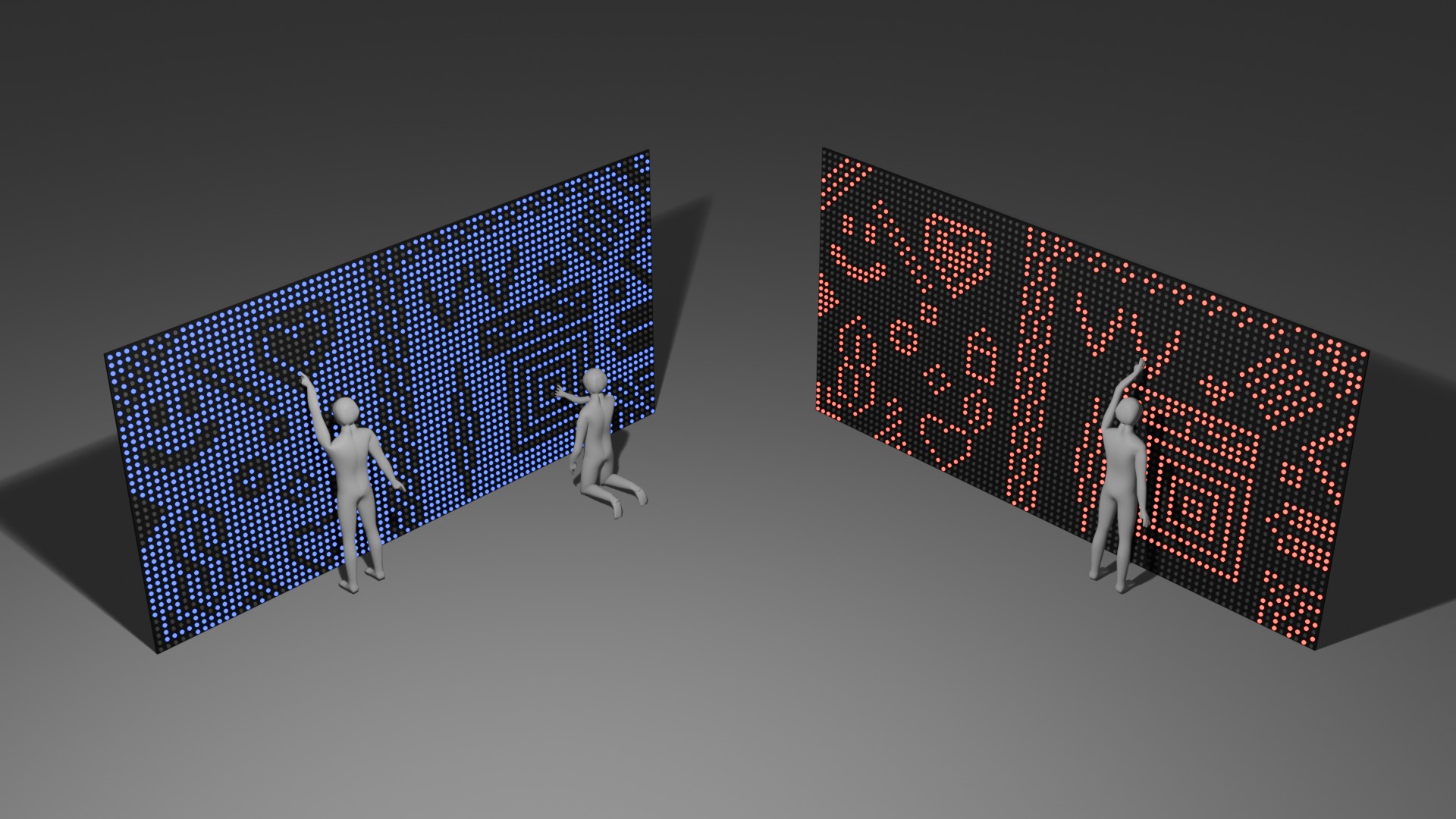
SYNC is two identical walls of illuminated buttons that share a single state: light a button on your side, and it goes dark on the other. The result is a playful tug of war in which the audience alone shapes an ever-changing pattern.
SYNC consists of two identical grids of illuminated buttons, set up as separate walls facing each other. Every button holds a single state, shared between both walls. Press a button on wall A and it lights up there. Press the same button on wall B and the light jumps across, switching off on wall A. Lit on one side always means dark on the other. That one rule turns every press into a small tug of war. You can try to write or draw something on your wall, but anyone on the other side can undo it with a single press of their own. From this minimal rule, driven purely by human input, an ever-changing pattern emerges, and no two moments look the same. That is what algorithmic art does: a minimal set of rules produces complex, living behaviour. It is a tempo of action and reaction, of building up and tearing down, set entirely by the audience.