
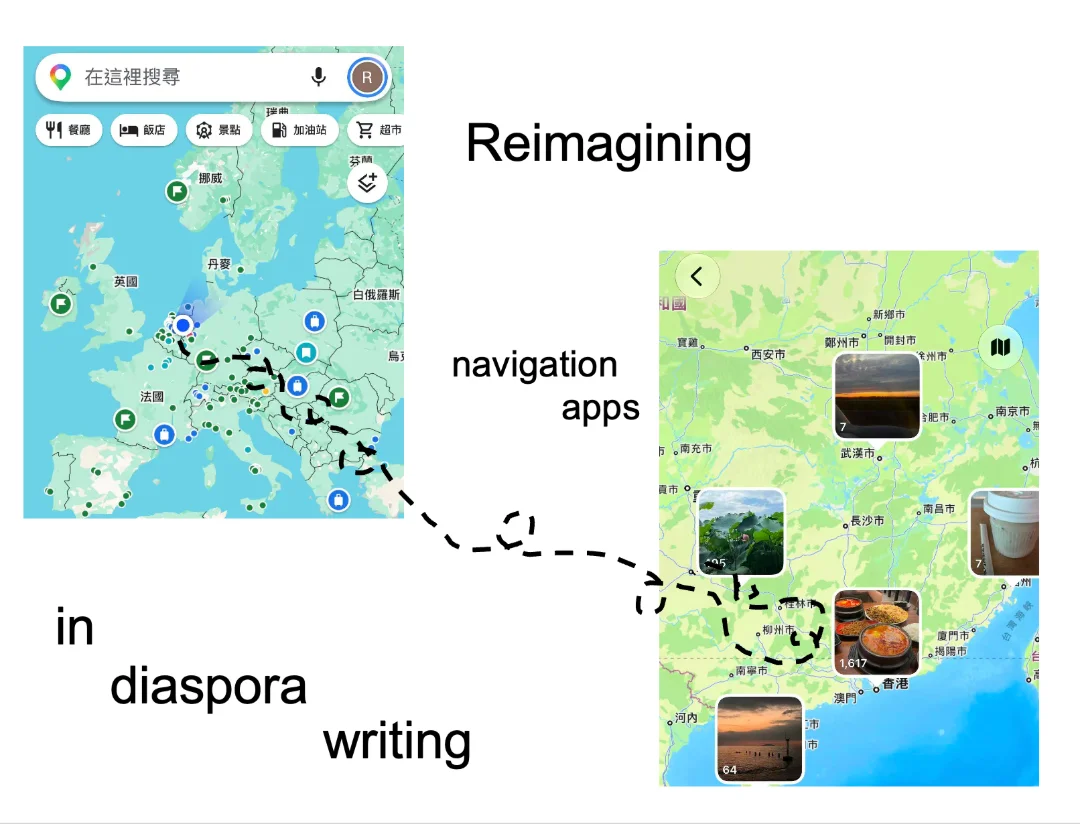
Reimagining navigation apps in diaspora writing
This workshop invites participants to reimagine how navigation apps, this invasive technology, could interact with people's memory and living experience, potentially offering us different perspectives on past life stories.
Navigation apps such as Google maps can be seen as invasive to individual living space due to their constant tracking of digital footprint and almost omnipresent street view capturing. This workshop invites participants to reimagine how this invasive technology could interact with people's memory and living experience, potentially offering us different perspectives on past life stories. Since age 18, I have been experiencing life as part of the Chinese diaspora, constantly observing and feeling the in-betweenness, the silence, and the gaps across different cultures. I have been trying to give voice to the diaspora community through commentaries on political affairs (as a political science major). However, it was only recently that I started writing about my childhood life as a way of personal recording. What shocked me is how many blanks and misalignments my memory has with other people's recollections and the real geographical conditions. The differences between memories is worth exploring, as they reflect how we perceive the environment and shape our identity. Incorporating the daily and commonly used navigation applications, this workshop aims to explore with the participants how daily technologies could be insightful in helping us think about what distance, transportation, route, and time are represented in this so-called "globally connected" world. We also hope to shed light on how invasive technologies shape our experience and memories of certain places by intentionally highlighting and ignoring them in digital representation.